
2026 Mitsubishi Outlander vs Mazda CX-5: Which SUV Fits Your Needs?
August 26 2026,
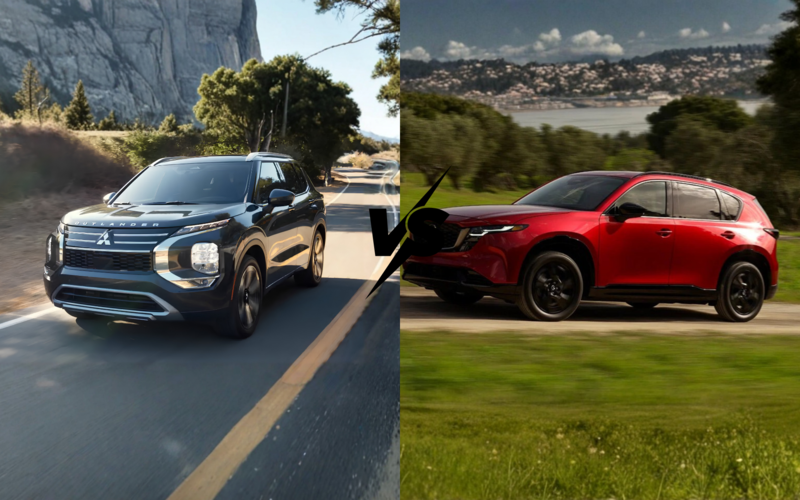
Choosing between two compact SUVs is about more than comparing horsepower or touchscreen sizes. For Canadian drivers, winter traction, passenger capacity, fuel economy, cargo flexibility, technology, and everyday comfort can have a much bigger impact on ownership.
The 2026 Mitsubishi Outlander and 2026 Mazda CX-5 take different approaches to the segment. The Mitsubishi combines a mild-hybrid turbocharged powertrain with standard S-AWC and three-row seating, while the all-new Mazda focuses on a five-passenger layout, standard AWD, and a significantly updated technology package. Here's how those differences translate into real-world value.
Build & Price your own 2026 Mitsubishi Outlander PHEV
Performance: Turbocharged Versatility vs. Proven Simplicity
The Outlander uses a 1.5-litre turbocharged four-cylinder engine with Mitsubishi's new 48-volt mild-hybrid system. It produces 174 horsepower and 206 lb-ft of torque, with a continuously variable transmission and standard Super All-Wheel Control (S-AWC).
That torque figure is particularly relevant in everyday driving. The mild-hybrid system's belt-driven starter-generator can provide additional assistance during acceleration from a stop, helping the SUV feel more responsive when pulling away from intersections or merging into traffic.
The Mazda takes a more conventional approach. Its 2.5-litre Skyactiv-G four-cylinder develops 187 horsepower and 186 lb-ft of torque, paired with a six-speed automatic transmission and standard i-Activ AWD.
So, the Mazda has the horsepower advantage, while the Mitsubishi produces more torque. The difference isn't simply about which number is larger: the Outlander's turbocharged setup emphasizes low-speed response, whereas the Mazda retains a naturally aspirated engine and traditional automatic transmission.
Quick Comparison
|
Feature |
2026 Mitsubishi Outlander |
2026 Mazda CX-5 |
|
Engine |
1.5-litre turbo four-cylinder + 48V mild hybrid |
2.5-litre Skyactiv-G four-cylinder |
|
Horsepower |
174 hp |
187 hp |
|
Torque |
206 lb-ft |
186 lb-ft |
|
Transmission |
CVT |
6-speed automatic |
|
Drivetrain |
Standard S-AWC AWD |
Standard i-Activ AWD |
|
Seating |
Up to 7 |
5 |
|
Ground Clearance |
210 mm |
To be verified by final Canadian spec |
Fuel Economy: A Small Mitsubishi Advantage
Fuel consumption is another area where the comparison gets interesting.
The Outlander is rated at 9.4 L/100 km city, 7.8 highway, and 8.7 combined.
Mazda lists the new CX-5 at up to 7.9 L/100 km highway, while the official Canadian specification sheet confirms the same 187-horsepower powertrain across the initial lineup.
Because Canadian fuel-consumption ratings can vary by configuration and final testing information, it is better not to overstate a direct combined-economy advantage without matching NRCan ratings for identical configurations.
For shoppers who drive significant annual mileage, however, fuel economy remains worth considering alongside purchase price, drivetrain, and driving habits.
Three Rows or Five? The Biggest Practical Difference

This is arguably the clearest distinction between the two SUVs
The Outlander offers 5+2 seating for up to seven occupants, giving families the option to use a third row when needed. It also offers selectable drive modes through S-AWC, including settings designed for different road conditions.
That extra seating can be valuable for school runs, carpooling, or occasional family trips. It also means buyers don't necessarily need to move into a larger three-row SUV.
The CX-5 takes a different approach with five-passenger seating. Mazda increased the new model's overall length by 4.5 inches, with most of the increase going to the wheelbase, creating a more spacious and stable-feeling cabin.
In other words, the choice is relatively straightforward. If occasional third-row seating is important, the Mitsubishi has a meaningful advantage. If five seats are enough, the Mazda concentrates its package around those occupants.
Technology: Two Very Different Approaches

The Outlander starts with a 12.3-inch Smartphone Link Display Audio system, wireless Apple CarPlay and Android Auto, and an eight-speaker Yamaha premium sound system. Higher trims can add a 12.3-inch digital driver display, multi-view camera, wireless charging, and a 10.8-inch head-up display.
The new CX-5 takes a more screen-focused approach. Even the GX includes a 12.9-inch centre touchscreen and Google built-in with navigation and voice assistance. The GT Premium can upgrade to a 15.6-inch display, along with a 360-degree View Monitor and Cruise & Traffic Support with Lane-Change Assist.
For technology-focused shoppers, the difference comes down to priorities. Mitsubishi offers a broad selection of available convenience hardware, while Mazda makes its new Google-based interface central to the redesigned cabin.
Safety: Comprehensive Assistance From Both
The Mitsubishi comes equipped with 11 airbags, Forward Collision Mitigation, Lane Departure Warning, Rear Cross Traffic Alert, Rear Automatic Emergency Braking, Blind Spot Warning, Driver Attention Alert, and Trailer Stability Assist. Higher trims add technologies such as Active Blind Spot Assist, Adaptive Cruise Control with Stop & Go, Lane Keep Assist, and Traffic Sign Recognition.
Mazda's 2026 CX-5 also brings an extensive standard driver-assistance package. The new model adds assistance technologies while retaining systems designed to monitor surrounding traffic and support the driver's awareness.
Neither system should be treated as a substitute for attentive driving. Instead, these technologies are most useful when they provide another layer of awareness during commuting, highway travel, and parking.
Which SUV Makes More Sense for Canadian Driving?
The Outlander stands out when versatility and passenger capacity are the priorities. Standard S-AWC, 210 mm of minimum ground clearance, selectable drive modes, mild-hybrid assistance, and available seven-passenger seating give it a particularly flexible profile for Canadian families.
The CX-5 takes a more focused approach. Its standard AWD, 187-horsepower naturally aspirated engine, six-speed automatic transmission, redesigned cabin, and new technology interface appeal to shoppers who don't need a third row and prefer a five-seat SUV.
Ultimately, neither vehicle is automatically the better choice for every driver. The Mitsubishi makes more sense for shoppers who need occasional extra seating and want the added versatility of S-AWC. The Mazda is worth a closer look for buyers who prefer a five-seat layout, conventional automatic transmission, and Mazda's new technology-focused interior.
Find Your SUV in Regina
A specification sheet can narrow the choices, but a test drive can reveal which seating position, powertrain, AWD system, and technology interface feels right for everyday driving. Visit Dilawri Mitsubishi in Regina to explore available inventory, ask about current offers and financing options, and arrange a test drive with the dealership team.